
 |
||||||||
|
|
|||||||
|
iPod Accessory Reviews: Speakers Bose SoundDockEditor's rating (1-5): Reviewed Dec. 17, 2005 by Lisa Gade, Editor in Chief Looking for big sound from the world's favorite MP3 player? Though the mighty iPod line of portable music players weigh in at only a few ounces, it's possible to fill a large room with tunes using the Bose SoundDock. The premier high end speaker system hit the market early and defined the quasi-portable big driver sound system for the iPod. Now there are a few competitors on the market, with more to come, so we decided to find out if the SoundDock can still hold its own.
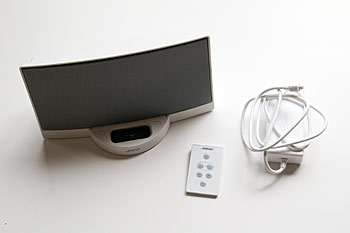
Let's get one thing straight: these aren't the kind of speakers you throw in your tote or suitcase for travel. If that's your bag, check out offerings such as Altec Lansing's inMotion iM3 or imMini portable speakers. The SoundDock measures nearly a foot across and weighs 4.56 pounds. Yes, that's portable but they're best used for room-filling sound rather than long trips: put it in your bedroom, carry it to the kitchen or back yard as needed. Bigger is better when it comes to speaker sound, so these will knock the pants off of 1 pound iPod speaker systems. And that's the reason to buy them; better sound. Not only that, they look good too! The SoundDock is compatible with any iPod that has a dock connector. We tested it with the Video iPod 5G and an iPod mini and each fit fine and worked well. Bose includes two additional dock adaptors to ensure a good fit, and a matching IR remote that controls power, volume and track playback. The Bose do not use batteries but rather AC and a large AC brick power supply is included in the box. The SoundDock will charge your iPod while it's in the dock. There are volume controls on the SoundDock as well, though those lack tactile feedback and we found ourselves using the remote even when in arm's length of the speakers. The speakers are magnetically shielded so they won't distort the image on nearby TVs or computer monitors. How do they sound? Home stereo audiophiles and home theater mavens will argue about Bose speakers quality. Audiophiles find them less accurate than other high end brands while home theater folks absolutely adore the separation, volume and great sound balance Bose gets out of relatively small drivers. Bose has definitely brought some of that home theater goodness to the SoundDock, without sacrificing overall audio accuracy. Though the speakers have less than a foot of physical separation, 3D imaging is quite good (a Bose hallmark) and music sounds full and rich. Bose does not provide frequency response or THD data, but our ears are guessing that both are good. Bose uses Active EQ, a DSP and compression circuitry, which they claim "balances output of all frequencies to provide natural tonal balance and clarity throughout the audio spectrum". That does make for a full sound, though dynamic range and the highs and lows suffer just a bit. Whether you like this is a matter of taste; like home theater, the most important frequencies are favored over the "flavoring" treble and bass sounds. For pop, rock and even some jazz, the sound treatment is very pleasing. Classical fans may prefer something with a little less mid-enhancing EQ such as the Klipsch iGroove speakers which have even greater dynamic range, sharp treble tones (flutes and triangles sound great!) and a deeper bass. The good side of the Bose is that highs are never grating, hissing or harsh: the EQ keeps the treble well-mannered. Let's face it, though these are large speakers by iPod standards, they're small by home stereo standards, and you can only get so much serious audio quality out of them. Rather than over-drive a bass than can only go so deep or let you hear highs that might verge on annoying (especially if you encode your music at low bitrates which introduces treble distortion), Bose EQs them down. However, if you're a classical fan and encode at higher bitrates, you might want less EQ and more highs and deep lows. The clipped dynamic range reminds me of early CD players that had a compression option because CDs offered so much dynamic range compared to the records they replaced. I personally would like a little more dynamic range, but the downside is you may find yourself using the remote often to reduce volume during loud passages and cranking it back up for the quiet ones. As an overall solution, Bose's EQ and compression should fit the tastes and needs of most music listeners. |
Advertisement |

|
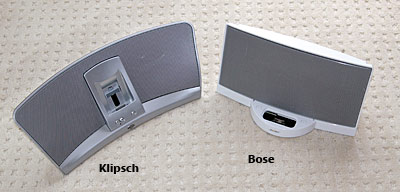
Above: Comparing the Klipsch iGroove and Bose SoundDock In terms of volume, the Bose can fill a small, busy cafe with sound as easily as your living room with a modest party brewing. Crank up the volume, as distortion is kept at a minimum even at high levels. Combine that with sound quality that beats the $150 and under super-portables and you've got a great sound solution that won't send you running back to the home stereo section at your local electronics retailer. |
Advertisement |
|
Conclusion Great sound from a relatively small system. Music sound is always pleasing with a surprising overall richness. The Bose have good bass and the highs are strong, though a tad under-emphasized. The SoundDock Digital Music System is definitely good enough to bring very good sound to your bedroom, kitchen, yard or small store. You won't wish you had a full-size home stereo system: the sound is that good. Pro: Great sound, very good 3D separation for a system this small. Excellent volume that doesn't distort. Sound is never harsh and bass is clear. Works with all iPods except the Shuffle and charges your iPod too. Remote has good range. Easy to move from room to room. Con: EQ and compression not perfect for classical music, consider the Klipsch iGroove instead or the Altec Lansing inMotion iM7. No 3.5mm jack to use speakers with other portable audio devices. Must be plugged into AC, can't use batteries. Comparing the Bose, Klipsch and Altec Lansing iM7 portable speaker systems Bose vs. Klipsch iGroove: Bose have a more compressed dynamic range and are more mid-range oriented, creating a full, rich sound that's easy on the ears. The Klipsch have great dynamic range, sharper highs and a bit more bass. Klipsch iGroove is a bit wider and can also work with other 3.5mm portable stereo devices. Bose vs. Altec Lansing iM7: The iM7 is louder with the best bass of the bunch. It can run on batteries as well as AC and works with other 3.5mm portable stereo devices. There's more high treble on the iM7 but the Bose will never sound harsh on the highs since they're EQ'd down. The Bose SoundDock is considerably smaller and lighter than the iM7. Price: $299 Web Site: www.bose.com Comparison Shopping: Where to Buy
|