|
|||||||||||||
|
|||||||||||||
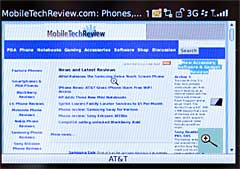
Phone, Reception and 3G Data The BlackBerry Bold is a quad band GSM world phone that works anywhere GSM service is available and it has 3G HSDPA on the US 850/1900 bands as well as 2100MHz for Europe and Asia. This is the first 3G BlackBerry for GSM networks (strangely, there have been EVDO BlackBerry phones for CDMA networks for quite some time). You'd think the web browser would fly with a strong 3G signal, but we found that page load times weren't hugely faster than the 2G EDGE BlackBerry Curve and 8800 on AT&T. Granted, EDGE BlackBerry smartphones loaded pages quickly by 2G standards, but the Bold isn't going to win against other recent 3G PDA and smartphones on AT&T's network. RIM's web browser, which handles WAP and full HTML sites evolves slowly over time and it's decent but still feels a few paces behind Nokia's webkit-based S60 browser on the Nokia E71, Safari on the iPhone 3G and Opera Mobile on recent HTC Touch phones like the Sprint Touch Pro and US 3G Diamond. The Bold's browser initially presents a zoomed out view of web pages (but not the entire page in overview) and you must press the trackball to zoom in to read text or select links. You'll need to press the menu key and select "Go to..." to enter a URL or change browser settings. There's a column view for those who want their info quick and dirty rather than desktop-pretty and options to allow popups and enable/disable Javascript. As with prior BlackBerry models, turning on Javascript can wreak havoc as some scripts (those commonly used for ads) can boggle and slow the browser to a crawl.
The BlackBerry web browser displaying our home page. Reception is very good if coverage is strong. But we saw a little of the iPhone 3G's (before firmware updates) famous waffling between 3G and EDGE in marginal coverage areas. If the 3G signal isn't fairly good (-95 db or better), the Bold will stay firmly on EDGE, while the Samsung Epix and HTC Touch Diamond managed to stay on 3G. There's no option to set the phone to EDGE (2G) only, as there are on many other 3G phones. This option exists on import Bolds but not the AT&T version of the phone. The drawback is that the BlackBerry's battery life will suffer when in an area with no or little 3G coverage as the phone hunts for 3G. Also if you're in a marginal 3G coverage area, the phone will frequently switch between EDGE and 3G, reducing battery life and increasing the likelihood of dropped calls. However, if you're in a solid 3G coverage area, or in an area with no 3G at all, then this won't be an issue. Call quality is excellent, with near-landline voice quality on 3G and very good quality on GSM. The volume is good by GSM standards, and we had no trouble hearing our caller in a somewhat noisy public location. The speakerphone's volume is good, and clarity is average. Bluetooth headset compatibility and call quality are very good: we tested the Bold with the Plantronics Discovery 925, Jawbone II and Samsung WEP200.
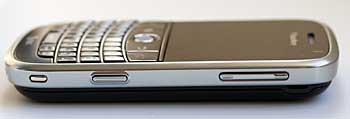
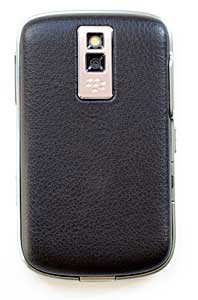
The usual BlackBerry push email goodness is here in full force. The phone supports up to 10 personal email accounts and works with BIS, BES and even non-BlackBerry plans if you don't wish to use BlackBerry email services (it's unlikely AT&T will let you out the door with a new contract and no BlackBerry data plan though). In addition, there's the usual BlackBerry Messenger (BlackBerry to BlackBerry messaging), SMS and MMS support but no pre-installed IM client. Want to view those email attachments? No problem. RIM and AT&T include Data Viz Documents to Go for BlackBerry, comprised of viewers for MS Word, Excel and PowerPoint documents. You'll have to upgrade to the Premium edition if you wish to create documents. Multimedia BlackBerry phones have always been a little picky about video formats. RIM lists Bold support for 3gp, some MPEG4, some DiVX and we found that most MPEG4 format files (such as those encoded for the iPhone and iPod) worked fine, but it was tricky to find the right codecs for DIVX and forget MPEG1 (will not play) and WMVs (audio but not video played). With MPEG4, playback quality was excellent. The screen is gorgeous for video playback and the Bold handled QVGA video up to 600kbps well with no frame drops or loss of audio sync. The media player also handles music with wide format support: MP3, unprotected AAC, and WMA. Sound quality is good and even the built-in speaker is decent, though you'll want to use a wired or Bluetooth stereo headset for superior quality. The camera is OK, but at 2 megapixels with a fixed focus lens, it's nothing that excites. Photos are sharp by 2MP standards and colors are pleasing; in fact it's one of the better 2MP cameras on the market. Sharpening is used judiciously and we don't see any of the painfully sharp edges that are common to HTC's 3MP cameras on default settings. At the same time, images are clear and focused and aren't too soft. Max photo resolution is 1600 x 1200, and there are a variety of lesser resolutions suitable for photo caller ID and MMS. There's an LED flash to help just a bit with low light settings and a dedicated camera key on the smartphone's lower right side.
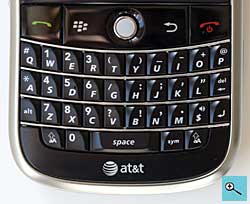
The Bold can shoot video at two resolutions: 480 x 320 (surprisingly large) and 176 x 144 for MMS. Video is recorded at 15fps in 3GP format, and quality is OK but not impressive despite the high resolution. We noted artifacting (it looks like the pixels are dancing), but the colors were good even in lower light settings. GPS The BlackBerry Bold has a built-in GPS with aGPS (tower-assisted GPS to speed up location fixes). The GPS works with AT&T Navigator (the new name for TeleNav), which requires a data plan since maps are downloaded on the fly, and the Navigator service itself costs $9.99/month or $99/year. The Bold managed quick and accurate fixes and stayed on course with us even on the highway. Navigator is a very good mapping application that provides spoken turn-by-turn directions, POIs and a variety of on-screen map presentations. Its directions are generally logical and accurate, and voice prompts come early enough to avoid hasty maneuvers. Battery Life The Bold comes with a 1500mAh battery, which is a healthy capacity for a 3G smartphone. Given the large, bright display, fast CPU, 3G and various wireless radios, the Bold needs plenty of juice. That said, by 3G HSDPA standards, the BlackBerry Bold has better than average battery life, and easily made it through the day on a charge with heavy use. We have generally broad and good 3G coverage in our area, so our tests are based on 3G not EDGE. If you're in a non-3G area, battery life should be longer. If you're coming from another 3G phone, you'll likely be pleased with the Bold's battery life. If you're upgrading from an EDGE BlackBerry, expect shorter battery life since 2G/EDGE consumes less power than 3G. Conclusion No doubt, it's bold, it's beautiful (whoever though we'd get to say that about a BlackBerry?) and it's laden with features like a high res display, fast CPU, GPS, WiFi, excellent keyboard and the usual BlackBerry push email goodness. The AT&T Bold is also a large phone and relatively expensive for a 'Berry-- alas, nothing is perfect. But if you're a BlackBerry addict looking for the top of the line, this and the BlackBerry Storm are it. Though for traditionalists, the Storm isn't necessarily attractive since it loses the usual strong BlackBerry hardware keyboard and adds a touch screen. Oddly given the likely greater expense of building the Storm, it looks like a relative bargain at $199 with a 2 year contract, and we hope that AT&T revises the Bold's price down sooner rather than later to compete. Pro: Fantastic display! Very good keyboard. Responsive and stable. Video player performance is likewise good. Great call quality, good GPS performance and reliable WiFi connections. Con: Large, pricey. Web browser is just OK. Some reception issues in weak 3G areas and there's no way to turn off 3G.
Price: $399 with 2 year contract, $299 after AT&T's $100 rebate (rebate requires data or messaging plan + voice plan). Web sites: wireless.att.com, www.blackberry.com
| |||||||||||||