|
|||||||||||||||||||
|
|||||||||||||||||||
The Nokia N90 is a tri-band GSM mobile phone that operates on the 900, 1800 and 1900 MHz bands. We wish all of Nokia's Nseries phones were quad band, but alas some are still triband. In the US, T-Mobile mainly operates on the 1900 MHz and Cingular on the 850 MHz band, which means that the N90 is a good choice for T-Mobile customers but not Cingular customers. The Nokia Series 60 phones (like the Nokia 6682 and the Nokia 7610) have earned a reputation for having remarkable reception, however the N90 isn’t the top of line when it comes to phone reception among S60 devices. That being said, the N90 has good reception and you should have no trouble making and receiving phone calls in T-Mobile’s coverage areas rated “excellent” and “good”. In “fair” areas, the N90 might not acquire a signal. The voice quality via the earpiece on the Nokia N90 is sharp and clear. The volume isn’t the loudest we’ve heard on a phone, being louder than the GSM Treo 650 but quieter than the HP iPAQ hw6915. You can adjust the volume by pressing the left or right on the 5-way d-pad during a call. The loudspeaker on the N90 is super loud. You can turn on the speaker during a call by pressing the right function key above the call end key on your keypad. You can also put a call on hold, mute the call, make a new call or send MMS while in a call. The Nokia N90 also supports conference call, speed dialing (9 speed dial number with number 1 for voice mail), voice dialing and video calls. The N90 supports enhanced voice commands which is not dependent on the speaker’s voice. This means you don’t have to record any voice tags, the voice recognition software will compare your voice tag with the entries in Contacts when you give a command. To make a call via voice command, press the camera shutter button and wait for the on-screen prompt to speak a name for dialing. If you are in one of the countries where 3G (UMTS) is available, you can use the Nokia N90 to make video calls. You must have a 3G SIM card to use this feature in these areas. The Nokia N90 offers 6 profiles and you can create your own profiles with ringtones, video call tone and message alerts. To create new profile, go to Tools group and click on the Profile app. The fastest way to switch between profiles is by briefly pressing the power on/off button on top of the camera barrel; you will see a list of profile options along with lock keypad and lock phone options. The Nokia N90 has a GPRS Class 10 radio for data with EDGE support. In our tests on T-Mobile EDGE network we got decent but not stellar numbers using DSL Reports mobile speed test: 48k – 88kbit/sec. The GPRS EDGE speed is comparable to the Euro version of the Nokia 9300 communicator running on 1900 MHz which got about 68k on T-Mobile but much slower than the US version of the Nokia 9300 running on 850 MHz band which achieved over 140k on EDGE. The N90 works well as a wireless modem for laptops or PDAs via Bluetooth (DUN) with fast transfer rates.
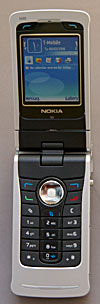
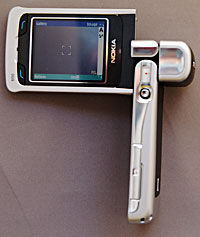
Horsepower and Performance The Nokia N90 runs on a 220 MHz ARM family processor, the same processor as the Nokia 6682. The processor speed is not shabby for a mobile phone, and it feels pretty zippy running most of the applications with exception of some web page loading and cold booting time of the phone radio. We attribute the slow browser app in part to the slow web page loading, though more recent Nseries models such as the N91 do load pages more quickly using the same T-Mobile EDGE connection. The device runs Symbian OS v8.1a and the S60 2nd Edition Feature Pack 3 platform. We're up to Symbian OS 9.1 and S60 3rd edition these days, and we have noticed that 3rd Edition has a faster UI and a much better browser. Still, the N90 is a pleasant and powerful device. The N90 comes with 6 MB of ROM and 48 MB of RAM of with 27 MB typically available for installing programs and storing data. 27MB is a healthy amount of space to store contacts, calendar items and some tunes, but if you are taking a lot of photos you will want to get some RS-MMC cards to store the images and videos. The N90 requires dual voltage RS-MMC cards (1.8/3v). The speed for saving large photos taken by the 2 mp camera to the card is surprisingly fast. Nokia states that heap size is unlimited (well, limited only by available memory), and TaskSpy reports that we had 11 MB of heap with no other apps loaded, which is quite large. Display and Multimedia When you use the display as the preview for that nice Car Zeiss optics lens, you’d better hope that it’s a good display. The Nokia N90’s 2.1 inch active matrix display doesn’t disappoint. It’s sharp and bright, has well balanced color and it feels roomy when displaying photos and videos. The swivel action adds some drama to the phone’s form factor and makes it easy to take photos in various angles. The 18 bit color support ensures the colors look saturated and zingy in photos and images. The display runs 352 x 416 resolution, text in email and on web pages are very readable. Below the display panel, you will find a light sensor that can help adjust the screen brightness automatically. The outer display is the usual affair found on most recent clamshell Nokia Smartphones such as the Nokia 9300. It’s 128 x 128 resolution with 16 bit color support. You can set the backgrounds and themes separately for the outer display in Settings which you will find in Tools app group. Images look great on the N90's sharp high res main display. Photos can be displayed in either portrait or landscape mode. Nokia included image print software that works with PictBridge compliant printers so that you can print your photos via a USB cable. You can also send photos via Bluetooth and MMS. In addition to the image software on the phone, Nokia also includes Adobe Photoshop Album 2.0 starter edition for the desktop. You can manage the photos you take with the phone in the Album and share them online. MP3 music sound quality is good through the earpiece and speakers, but superb through the stereo Pop-Port earbud headsets. Sound via the stereo headset has great clarity, the bass is strong and has great separation. Even percussion from small hand drums has fuller sound than you’d expect from a mobile phone. The loudspeaker has great volume. Nokia bundles RealPlayer to play music files and videos. The audio formats supported include AAC, AAC+, AMR, eAAC+, MIDI Tones (poly 64), MP3, RealAudio and WAV. RealPlayer also plays video on the N90. The supported formats include 3GPP ( .263), MPEG-4 and RealVideo. Movies play fairly smoothly, though there are some frame drops. However if you play the videos you have captured with the phone’s camera you'll be amazed at how great the quality is. There is no frame dropping, audio is in perfect sync with video and there's no ghosting and other ugly “poor mobile phone video” effects. Nokia has got the secret sauce down when it comes to building software that works with that 2 mp camera. Camera The 2.1 megapixel CCD camera is the N90's raison d'etre. When the phone came out in the second half of 2005, no other phone could compete, and as of this writing, it's still true (with the possible exception of the just released Nokia N93 which isn't yet available to us). Video quality is perhaps still the best we've seen from a camera phone, again with the possible exception of the N93. The camera has a very good quality (by phone standards) Carl Zeiss lens and has autofocus which generally makes for much sharper shots. Most other camera phones have fixed focus lenses which means they're always focused out to infinity— not perfect when your subject is only 5 feet away and there' s no way to get good depth of field (blurring of the background when taking portraits and macro shots). The images look like they were taken with something closer to a real dedicated digital camera, with more image depth, good tone and an overall naturalness. The bad news is that there is some noise and JPEG artifacting, even in daylight shots. But I'll take noise (easily removed with a noise reduction app or plugin) over poorly exposed, inaccurately colored images any day. And the Nokia N90 does a very good job with color accuracy, contrast and strong daylight (images don't blow out the highlights). Colors really pop and are more vibrant than the 3.2MP Samsung a990 on Verizon, Nokia N80, Nokia N91 as well as the Sony Ericsson W810i. Given how fast camera phones are progressing, the N90 won't seem like much in a year or two, but it and the Sony Ericsson K750i really set the stage for a more serious level of imaging in phones in the 2nd half of 2005. Standard "real" camera features like a flash with red eye reduction, automatic on and off settings, brightness adjustments, white balance and color adjustments are standard on the N90. You can shot in still, sequence or video modes and the camera has scene settings for landscape, portrait, night and sports. The flash has a maximum range of 1.5 meters (6.5 feet) which is good by phone standards. While phone videos are generally ugly, blocky messes, the N90's camcorder is superb. No blockiness, natural colors and smooth frame rates. Nice. It's actually good enough to capture those special moments when a full-fledged camcorder isn't handy. The camera can take video at a maximum resolution of 352 x 288 in MP4 format with audio.
Sample photos. Click on a photo to see the full size unedited version.
Bluetooth The Nokia N90 has integrated Bluetooth 1.2 with support for Basic Printing Profile, Generic Access Profile, Serial Port and DUN profiles, Headset and Handsfree, Generic Object Exchange, Object Push and File Transfer, Basic Imaging and HID profiles. Battery life does take a hit when using Bluetooth. Pairing an Intel iMac with the Nokia N90 was a breeze. Transferring an MP3 file that’s about 4.4 MB via Bluetooth took about 2 minutes. The Nokia's multi-tasking proves invaluable when you need to transfer new songs while listening to the current tune. You are only interrupted when the file transfer is done— your music volume is gracefully lowered and an inbox message alert will play twice, then resume the previous music volume level. The Nokia offers good data speeds when used as a modem for a PDAs and notebooks (including the Nokia 770) via Bluetooth DUN, and it works well with the Bluetooth portable keyboard offered by Nokia as an optional accessory. The Nokia N90 has both Headset and Handsfree profiles for compatibility with Bluetooth headsets and car kits. We tested it with several Bluetooth headsets and got good results with all. The lowest volume via a Bluetooth headset is the Jabra BT250. It has low incoming volume and the outgoing voice has slight crackling, range is about 15-20 feet. The Cardo scala-500 has very good volume on the incoming end and normal volume on the outgoing voice, range reached over 20 feet which is very good for this set up. Battery Life The Nokia N90 comes with a standard 760 mAh Lithium Ion rechargeable battery (BL-5B) that’s user replaceable. That’s not a huge capacity for a phone with 2 mp camera and flash as well as Bluetooth radio. The battery life isn’t great but not atrocious either. The claimed talk time is up to 3 hours and standby 12 days. The talk time seems to be on target to the claim but standby is much shorter than 12 days, especially if you are in areas that don't have strong coverage. Taking 10 photos, pairing the phone with a couple of Bluetooth headset, playing MP3s for ½ hour and browsing the web for 15 minutes can use up 1/3 of phone’s battery life. If you just play MP3s, the battery life is actually much better. Software Like all S60 phones, the Nokia N90 comes with PIM (Personal Information Management) software including Contacts, Calendar, Notes and To-do list. The Contacts application has similar features as the ones found on older Series 60 Nokia smartphones and it allows you to add personal ringing tones and caller ID photos to a contact card. It supports groups which allows you to email or text message to a group of recipients at the same time, and you can copy contacts to or from SIM cards. Other features in the Contacts application include setting a default phone number and email (since it allows you to input multiple numbers and email addresses for a single record), assign speed dial (8 assignable speed dials on the phone total) and synchronize the contacts to your desktop via included PC Suite or iSync on the Mac. The Calendar application offers the usual day view, week view and year view. When you enter a calendar you can choose the type of the even such as Meeting, Memo or Anniversary. The alarm functions include repeat, repeat until certain date and silence, stop and snooze when you need to quiet the alarms. In addition to the basic PIM applications, the Nokia N90 also offers a voice memo feature. The web browser bundled with the Nokia N90 is nothing to write home about. While it does support full HTML, xHTML and WAP 2.0, many full featured web sites (even without Flash and Active Script content) won’t load correctly or won’t load at all. So don’t expect to use this phone to replace your PDA or notebook's web browser. The email and messaging application however is much more capable, fortunately. You can use the Messaging application on the N90 for IM, SMS, MMS and email as long as your carrier supports these messaging features. The email client works well with attachments including Office documents, PDF files, music and image files as well as 3gp video attachments. The email app supports POP3, IMAP4 email, SMTP and you can set the email to auto-check messages periodically. Other useful applications bundled with the N90 include Memory card tool, IM application, File manager, World clock and more. The Nokia uses a Reduced Sized Dual Voltage (1.8/3V) MulitMediaCard. The Memory card tool app allows you to format a card, backup the phone memory, set password and gives you info about the used and free space on a card. The IM on the Nokia supports contact list, manager IM groups and record conversations. The File manager keeps track of your free memory, lets you view and manage your files in contacts, messages, images, ringing tones, calendar, documents, downloaded applications and more. Conclusion Were it not for Nokia, those who need a smartphone but also want a great camera would be sulking in the corner. The N90 is both a powerful smartphone with full syncing capabilities and a multimedia treat. Pros: Great camera hardware and software. Very nice high resolution screen for viewing photos and videos. Good reception for voice and data in areas where network coverage is excellent and good. It has 3G (UMTS) for video calls where 3G on the 2100MHz is available (that means not in the US where we use the 1900MHz band). Full PIM applications bundled and PC Suite for syncing to the desktop. Great stereo sound via stereo headsets for MP3 and movie playback. RS-MMC for storing more photos and videos. Con: Web browsing speed and the browser need to be better (as they are in more recent S60 phones from Nokia). No 850MHz band. Battery life isn't stellar. Though not poor, the N90's 1900MHz reception isn't as strong as other Nokia phones which are generally top performers. Price: $699 unlocked, without a service plan. $299 with a T-Mobile service plan (Wolf / Ritz Camera and Nokiausa.com offer it with a T-Mobile plan. T-Mobile stores do not carry this phone). Web site: www.nokia.com
| |||||||||||||||||||